Case Study · LensHH-LT
From a single BK7 lens to a 3-element design — in two clicks
Synthesis by Saddle-Point Construction grows an optical design one element at a time by finding saddle points in merit-vs-curvature space. Starting from a single biconvex N-BK7 lens, two SPC levels plus a Multistart polish drove the merit function down ~210× — and discovered an unbalanced 3-element layout (singlet pre-stop, cemented doublet post-stop) without a human picking the topology.
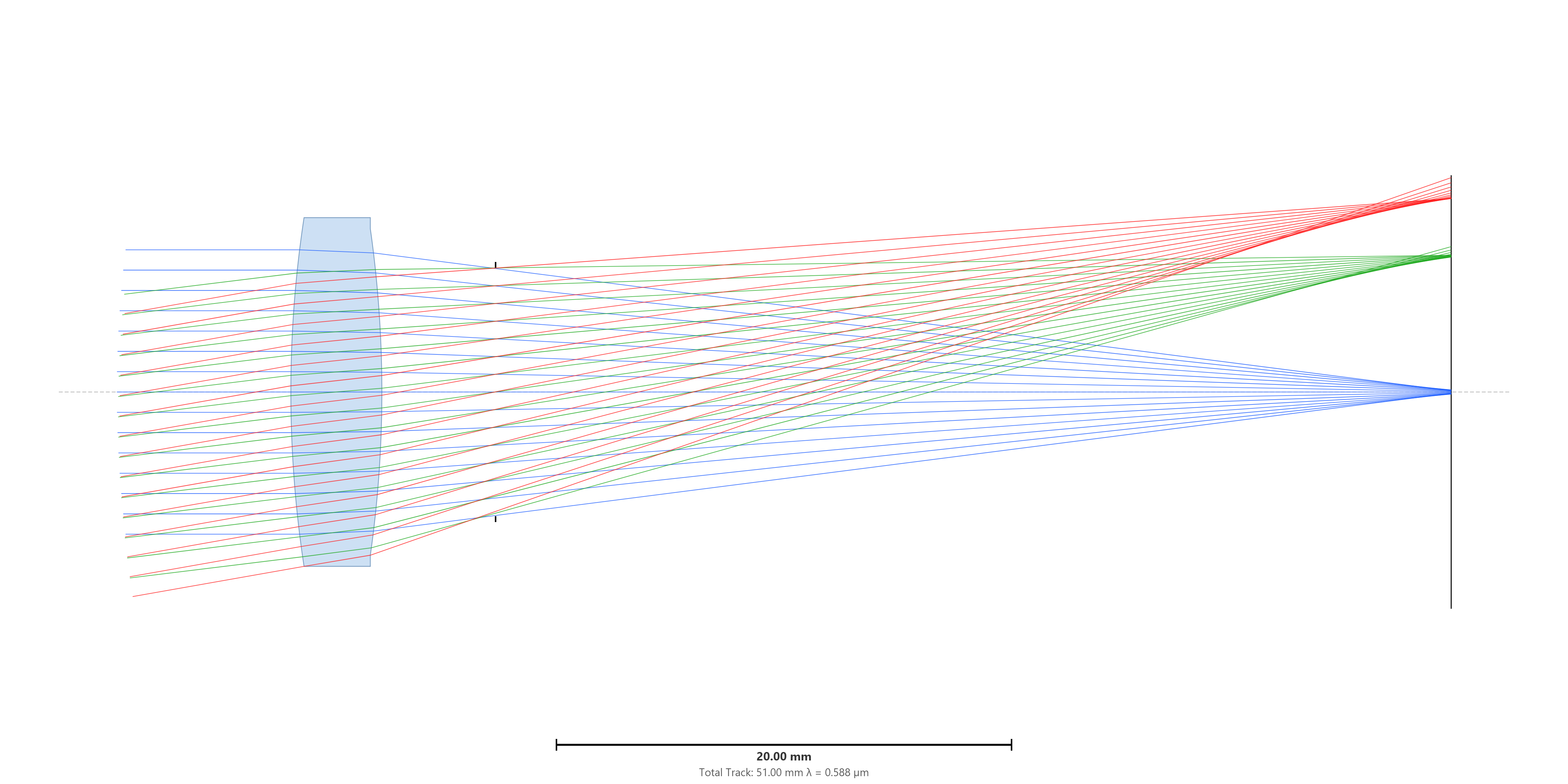
The starting design
A single biconvex N-BK7 element. 50 mm focal length, F/4 aperture
(12.5 mm entrance pupil), three field positions (0°/7°/10°), three visible
wavelengths (480/588/650 nm). Both curvatures and the centre
thickness are variable. Glass substitution is enabled on the lens
against a small filtered crown catalog. As a single element it
can't correct spherical aberration, coma, astigmatism, or
chromatic aberration simultaneously — the merit starts at
0.925.
The merit function
Standard image-quality plus boundary operands — but with one
addition that turns out to matter for SPC specifically: a
DTRG row (Diameter-to-Thickness Ratio,
Glass-only, bounds 2-10, weight 0.3) covering the whole inserted-element
span. SPC is unusually willing to make extreme element shapes; without
DTRG it lands on wafer-thin meniscus or brick-thick block
configurations that locally minimize aberration but can't be fabricated.
The bound enforces sane proportions: with limits [2, 10],
centre thickness can be at most half the diameter
(no super-thick blocks) and at least one tenth of the diameter
(no wafers).
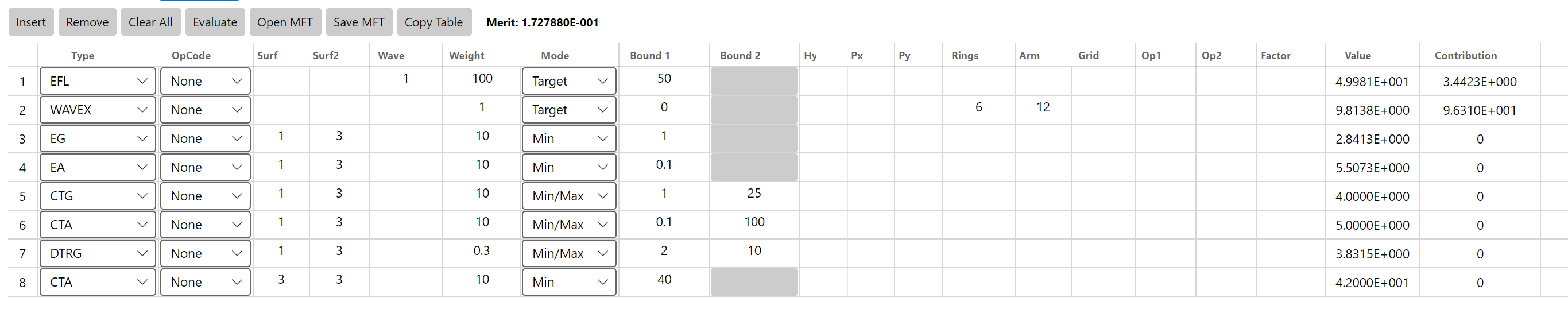
DTRG row (#7) and the dedicated BFL CTA row (#8). Boundary operands span the inserted range.SPC settings
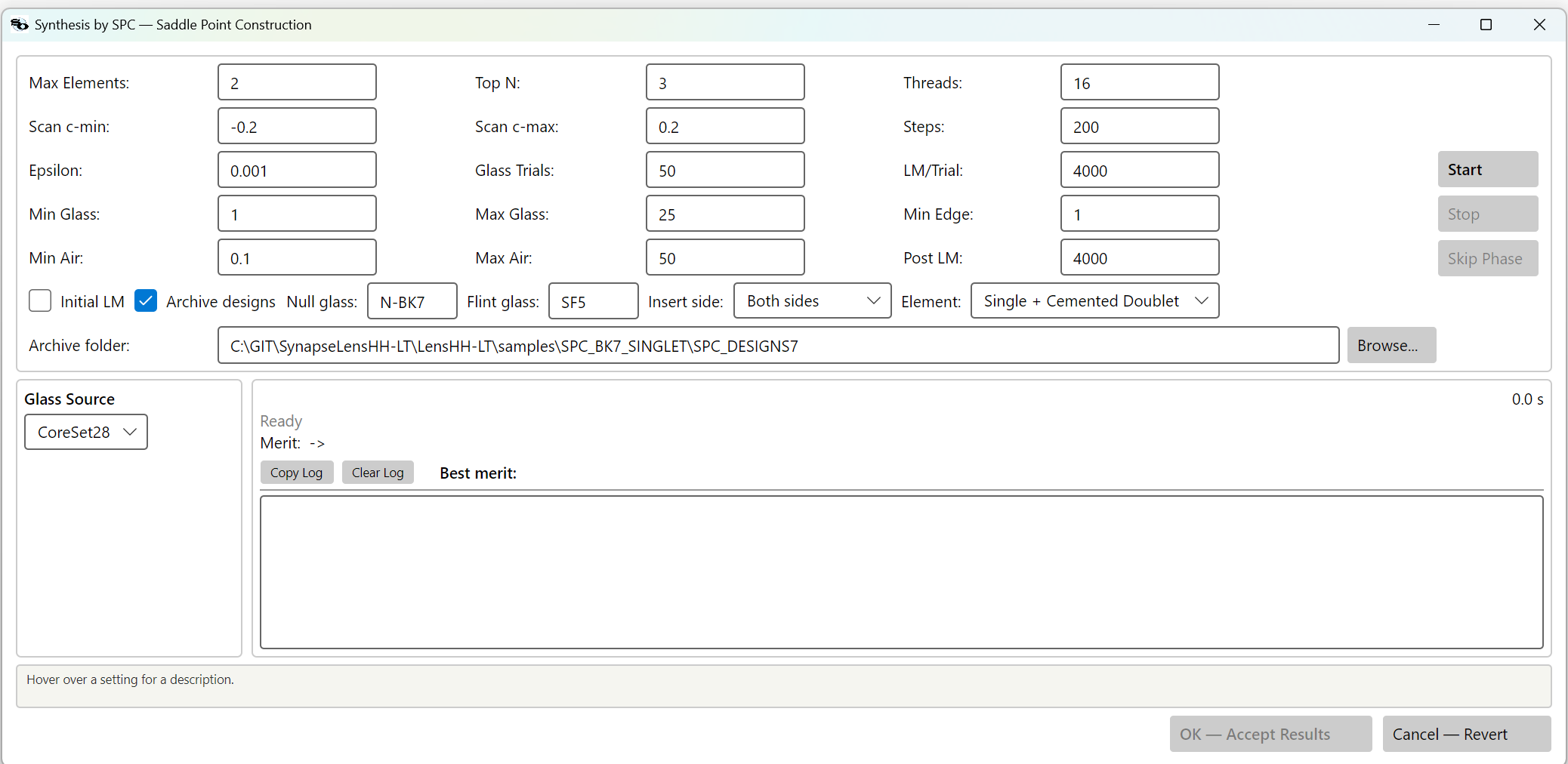
The defaults work out of the box, but two non-default knobs
mattered: the curvature scan range was widened to ±0.2
(default ±0.1) and the number of scan steps was
doubled to 200. The BK7 design's saddles sit out near
c ≈ 0.07 — at the edge of the default window. The
element type was set to Single + Cemented Doublet
so the Top-N ranking could pick the best topology level by level.
What SPC did
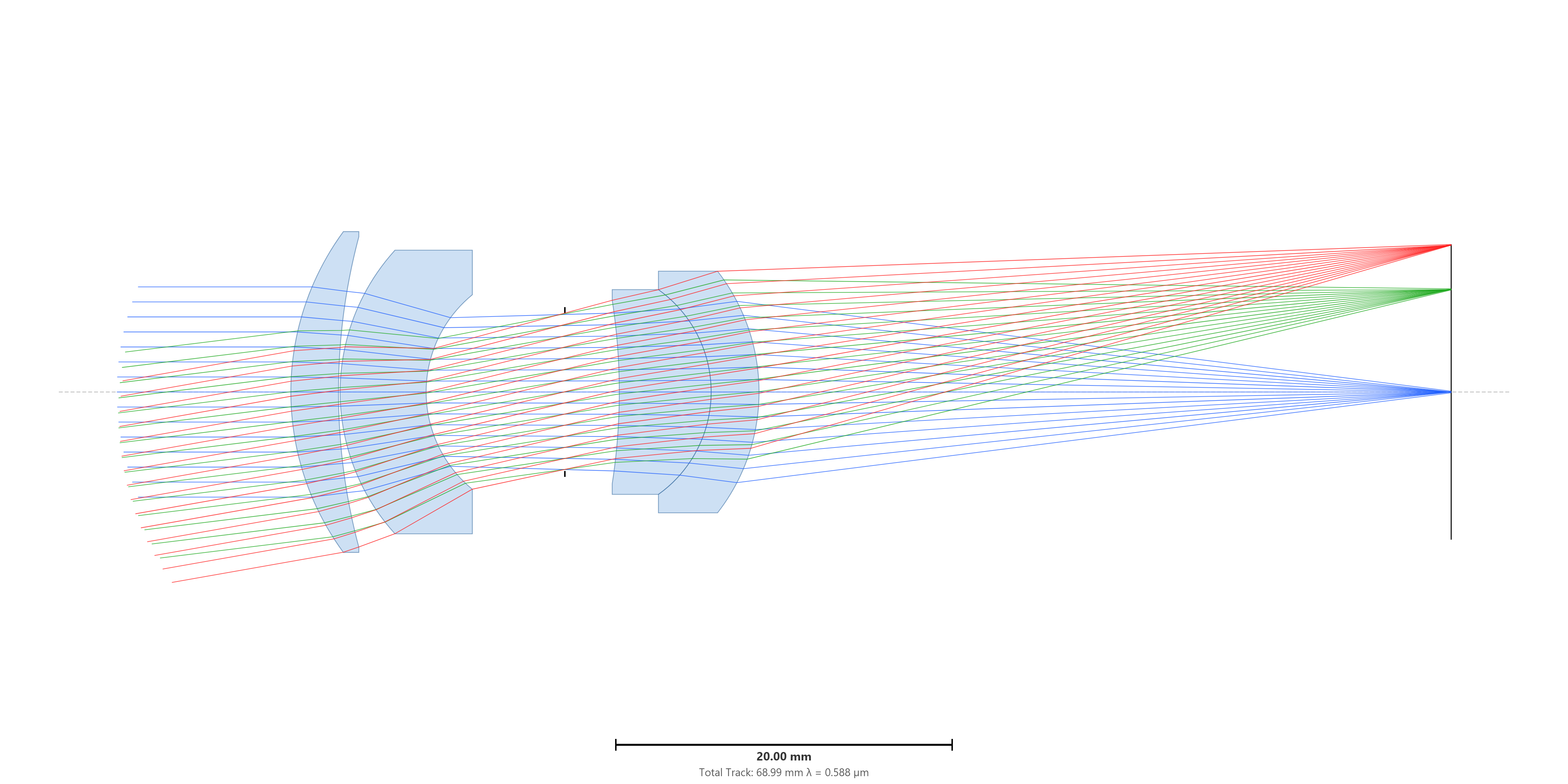
SPC ran two insertion levels. At each level it scanned every air gap in the surviving designs for saddles, branched into two local minima at each saddle, ran a bootstrap LM to grow the new element from infinitesimal thickness to a real one, then a full LM, then glass trials over the catalog. The Top-N survivors became the seeds for the next level.
| Phase | Best merit | What happened |
|---|---|---|
| Start | 0.925 | Single biconvex N-BK7. |
| L1 best | 0.0192 | First insertion: a singlet on the pre-stop side. ~48× drop from start. |
| L2 best | 0.00622 | Second insertion: a cemented doublet on the post-stop side. SPC output. |
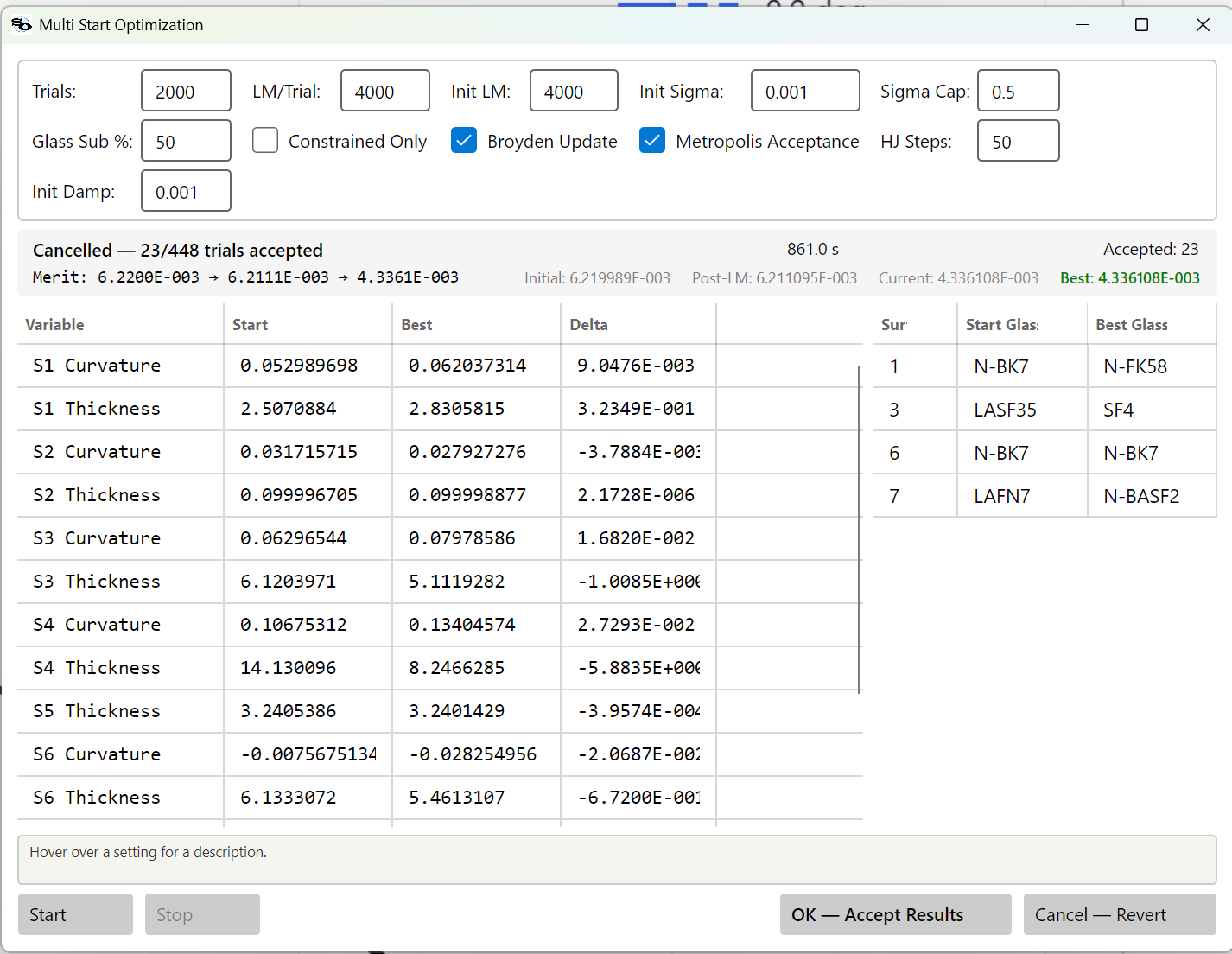
| + Multistart polish | 0.00434 | Multistart with glass substitution; 23 / 648 trials accepted, ~30 % further drop. Three of four glass picks shuffled (S1: BK7 → N-FK58, S3: LASF35 → SF4, S7: LAFN7 → N-BASF2). |
Final topology: an N-FK58 meniscus and an SF4 element pre-stop, then an N-BK7 + N-BASF2 cemented doublet post-stop. The "Single + Cemented Doublet" mode let the Top-N ranking pick a single element at one level and a cemented doublet at the other — exactly the unbalanced topology this aperture / field combination wants, and one that wasn't pre-specified anywhere.
The result
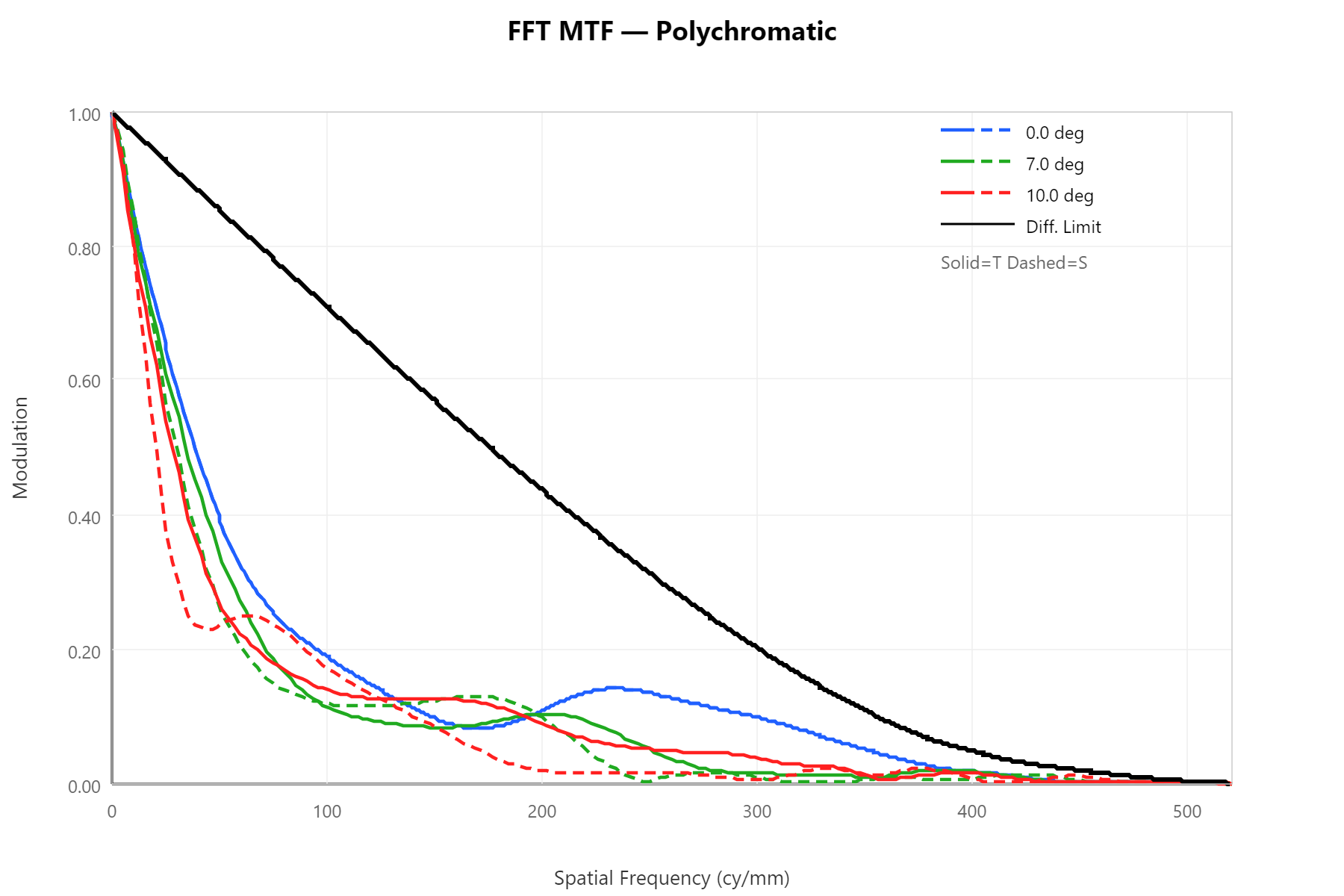
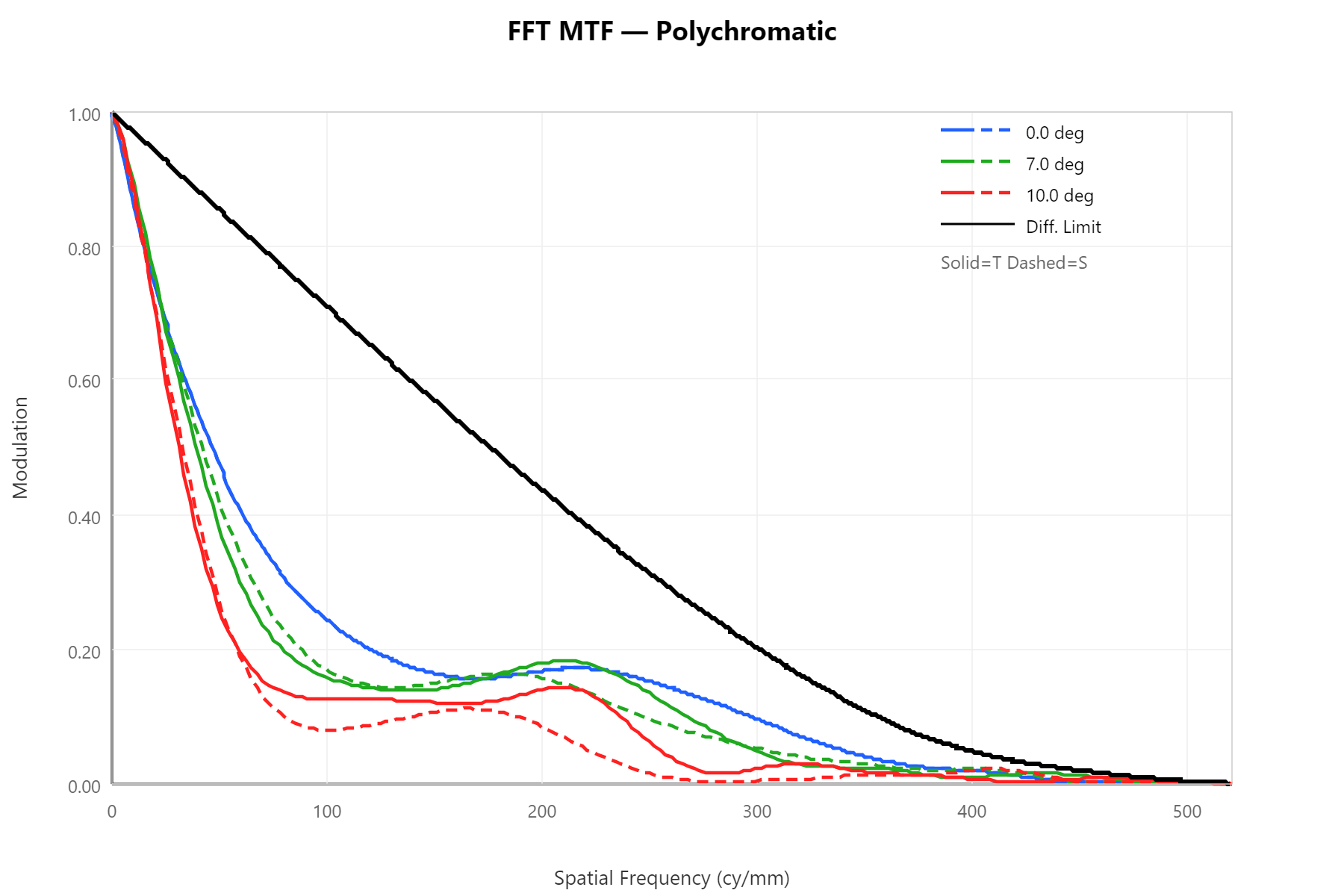
FFT MTF
What's worth taking away
- SPC discovers topology. A human didn't specify "put one singlet here and a doublet there" — SPC found that layout by ranking saddle-point branches across both topology choices.
- Pair SPC with Multistart for the polish. SPC's per-branch glass trials sample only a subset and its per-branch LM is bounded — Multistart with glass substitution found ~30 % further improvement and three better glass picks.
-
Bound proportions with
DTRG. Without it, SPC happily lands on element shapes that minimize aberration on paper but can't be made.
Run this yourself
The starting design and final result ship with LensHH-LT in the
samples folder. Open BK7_UC.lhlt, run Optimization →
Synthesis by SPC, and you'll see the same trajectory in your own
log window.